Property Description
East Worlington House is located in a prominent position in East Worlington Village with its south elevation facing the river Little Dart and the woods beyond. The exact date of construction is not known however archaeologists using the evidence available to them suggest it is a C17th building. As no other use can be identified it is presumed to have been constructed as a rectory, and extended through several different stages. The main original building materials are cob walls siting on stone foundation walls and a thatched roof.
It remained as rectory until 1967 when it ceased to have ecclesiastical use and was sold as a private dwelling.
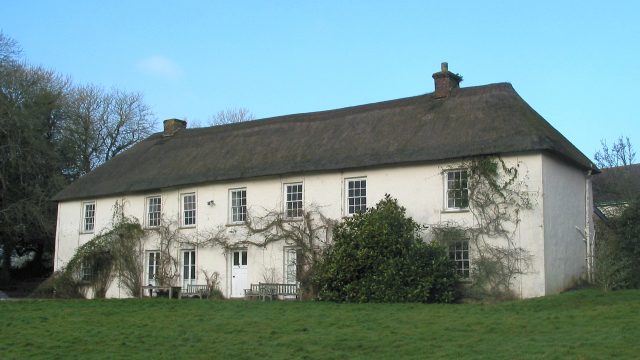
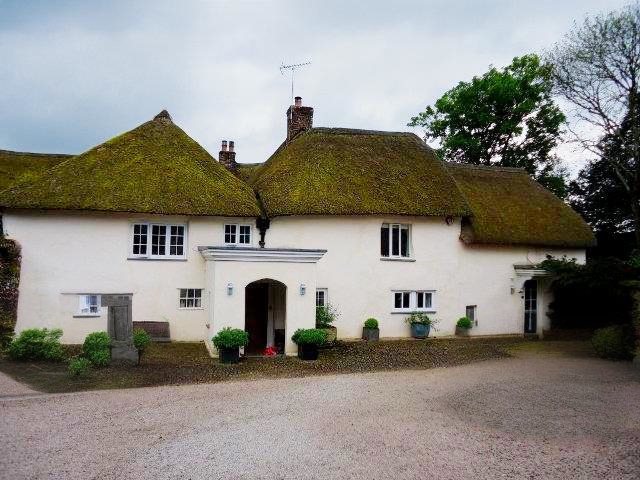
The north elevation of the house faces into a court yard area which is enclosed on its west side by a building previously a barn and now converted into East Worlington Parish Hall, on the north side by a number of buildings including a stable, now converted into holiday accommodation and to the east by a garage, greenhouse, and garden.
Between the House and the river is closest to the house a formal garden consisting mainly of a lawned area boarded on its southern edge partly by a metal post and rail fence and partly by a ha ha.
Beyond the ha ha a meadow goes down the hill, which finally levels off in the valley and carries on to the river as the southern boundary of the meadow.
East Worlington House Fact File
-
Earliest Record
The first reference to a priest in East Worlington is in 1261 with the installation of Robert de Hendeville. Despite the first reference to East Worlington House is in a Church of England inventory (Glebe Terrier) in 1679. It was described as a house with mud walls with part stone to the front. On the site of the house there was also a dairy, malt house, a barn, a shippen (cow barn) and a stable. The presence of a malt house indicates that beer was being brewed, however it is not known if this was solely for the household or if the rector of East Worlington had a handy side-line in selling beer to boost his income. -
Demolition of Cottage
In 1895 a petition was made under the Ecclesiastical Dilapidation Act of 1871 to demolish a coachman’s cottage, washhouse, and linhay (farm building) which were described as being in very poor condition. The purpose of the act was to ensure rectors took care of church property, but permitted buildings to be demolished when the cost of repair exceeded the value of the property. This petition required the consent of both the Bishop of Exeter and the Right Honourable Newton Fellows, Earl of Portsmouth who was the patron for East Worlington Church and Parsonage. -
Valuation in 19th Century
In 1831 East Worlington House was described in White’s Devonshire Directory as a neat thatched residence with 66.5 acres of glebe (land that provided income for a clergyman) and valued at £238. It is not clear if this is the value of the property as we would understand it today or whether this was a reference to the income that it generated on an annual basis.
Talking of income, up until 1936 money to support the local clergyman and also to maintain the church came from tithes.
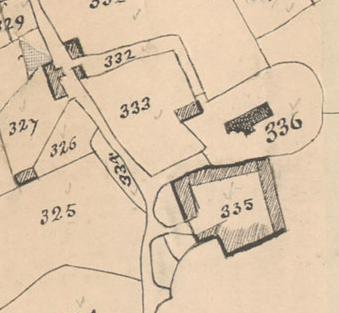 A tithe was a tax on local landowners and farmers who had to give one-tenth of their annual agricultural produce (crops, livestock, etc.) directly to the local clergyman. In 1936 the old practice of payment in physical goods and farm produce was replaced by a fixed, regular money payment. The value of the local tithe payment for East Worlington was calculated at £207 9s 10d per year.
 -
Tithe Barn
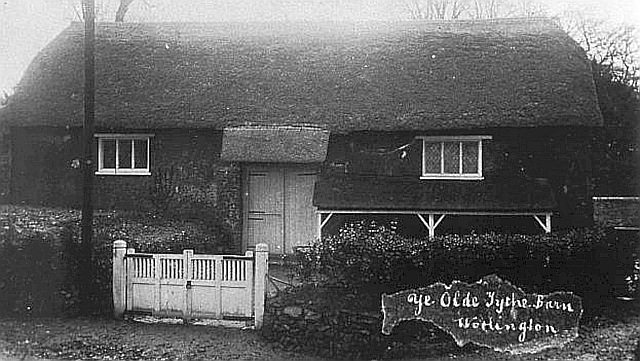
Before 1936 the current East Worlington Parish Hall, which was then part of the rectory of East Worlington House was used to store tithes. We know this because over eighty years after the abolishment of physical tithes it was still being referred to as âYe Olde Tythe Barn”.
From the mid 1800’s onwards, the barn had been used as a venue for different community activities. It was sold, in 1920 as a Parish Hall for community use and was purchased by the Parish Council. The building Grade II listed, and has been subject to different phases of renovation, improvement and internal modernisation.
-
Poor House
At some point in the 19th century the local poor house (a property for housing orphans or the destitute) was one of the stables at East Worlington House (from an early 20th century description by Rev. H. A. Hill ??). It is also known that the poor house occupied a site in what is now East Worlington School and it is unclear if this is the aforementioned stable or whether this indicated an upgrade for the poor. The poor house subsequently relocated to what is now South View Cottage in West Worlington. -
Very Nearly Demolished
In an account entitled “The Evolution of a Devonshire Rectory”, indicates that in the early 20th century the house had fallen badly into disrepair; so much so it was recommended for demolition . Fortunately the Church of England financed the necessary repairs, and the house survived. -
House Sold
The property was sold on the open market for the first time in 1958.
After the Second World War the Church of England began a policy of selling off of rectories and vicarages. The primary reason was almost certainly financial, as the buildings were often large and expensive to maintain. In 1958 the living of East Worlington House ceased when it the ecclesiastical parish was amalgamated with West Worlington. and the house was sold into private ownership in 1967.
-
Grade II* Listing in 1967
East Worlington house property is listed as a Grade II*. The details of the listing can be found on the Historic England website. Listed buildings are buildings of special architectural or historic interest with legal protection. Only around 5.8% of listed buildings are Grade II*, which highlights the importance of East Worlington House in the locality.
-
Hub of Community Events
The house and grounds provide has long provided a venue for community events and celebrations. These include the annual village fete, the Riverside Rocks concert, Crocus and Cream Teas (under the National Garden Scheme) and Duck Race and Dog Show (in support of East Worlington School). Every four years the grounds are also used for the much enjoyed local WorlyOlympics.
Property Development Timeline
5b: The construction of a wing adjacent (to the east) of the link, with a further building probably agricultural?) added to the north-east of the Phase 1 chamber block.
Press Cuttings
The Property Is More Than The House
Natural Crocus Display in the Garden
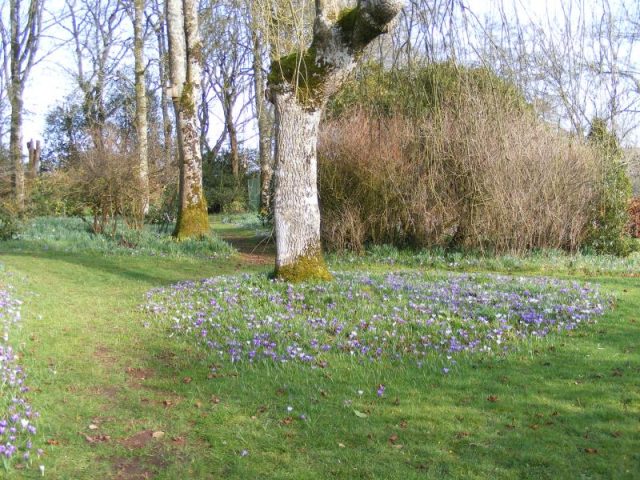
One of the natural features of the property is the extensive display of crocuses that have spread over many years in an area of the garden to the East of the house. The display is of national interests as they are recognized by the National Garden Scheme and forms part of their annual programme of privately own gardens open to the public The crocuses are at their best in late February early March, depending on the weather conditions The crocuses, as is the rest of the garden and the grounds of the property are well maintained and in immaculate condition as a result of the dedication of the owners of the property Barnabas and Campie Hurst-Bannister.
National Garden Scheme
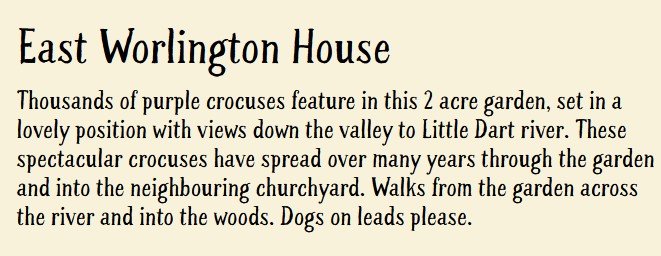
The National Garden Scheme (NGS) is a UK charity that opens thousands of beautiful private gardens in England, Wales, NI, & Channel Islands to the public, raising millions for nursing and health charities (like Marie Curie, Macmillan, Hospice UK) through admissions, tea, and cake, while also promoting the health benefits of gardens through its “Gardens & Health” program. It’s a long-standing tradition, started in 1927, offering unique access to diverse gardens, from grand estates to hidden gems, for charity and well-being.
This cutting is an extract from the publicity promoting the scheme and advertising the location, directions, facilities and the details of opening, of the specific properties.
Extract of text from the press cutting taken from Devon Live 2025
‘The crocuses, which have spread naturally over many years, create a striking display across the two-acre garden and the neighbouring churchyard. The garden, set in a picturesque location with views down the valley to the Little Dart river, offers visitors the chance to explore beyond the flowers. Guests are welcome to walk down to the river, cross the bridge into the wildflower meadow-though not yet in bloom – and follow the public footpaths into the woods.
Stories
In Poor Condition – Dilapidation the Reverend Benjamin Clay Era and Consequences

Evolution of a Devonshire Rectory
The booklet below describes East Worlington House from the 17th through to the early 20th centuries. The date and authorship are uncertain and if anyone has any further information on this then please get in touch.