
Wolrington residents relate their memories about growing up during the war or recall family stories about events in WWII.
Aubrey Hosegood (senior) with his wife Jane were the farmers at Yetheridge Farm, Worlington during the war years. Farming was a “Reserved Occupation” so that Aubrey did not join the services.
They are a long established family there as the family had bought the farm in 1901.
During the war years, they were joined by three other people who worked on the farm.
- 1An evacuee named Walter Green who is still living in the Southampton area. He does not appear listed in the Worlington School evacuee list, so maybe he was a young teenager who stayed and helped on the farm.
- A man named Ivan Spalletti ( his name appears on the back of the photograph as Ivan Spaghetti but it is thought now that it was probably Spalletti) [Ed: Ivan Spaduti] Ivan lived in Witheridge and worked on the farm. He married a lady called Jane.
- A Prisoner of War named Hans who lived on the farm. The advent of tractors and machines rather than horse power, meant that “feeding the nation” was becoming
more mechanised.
Geoffrey Hosegood remembers that his grandfather bought one of the last three Allis-Chalmers tractors which had been shipped to England from the States in
1939 and registered in 1941/2 They also had an Allis-Chalmers round bailing machine.
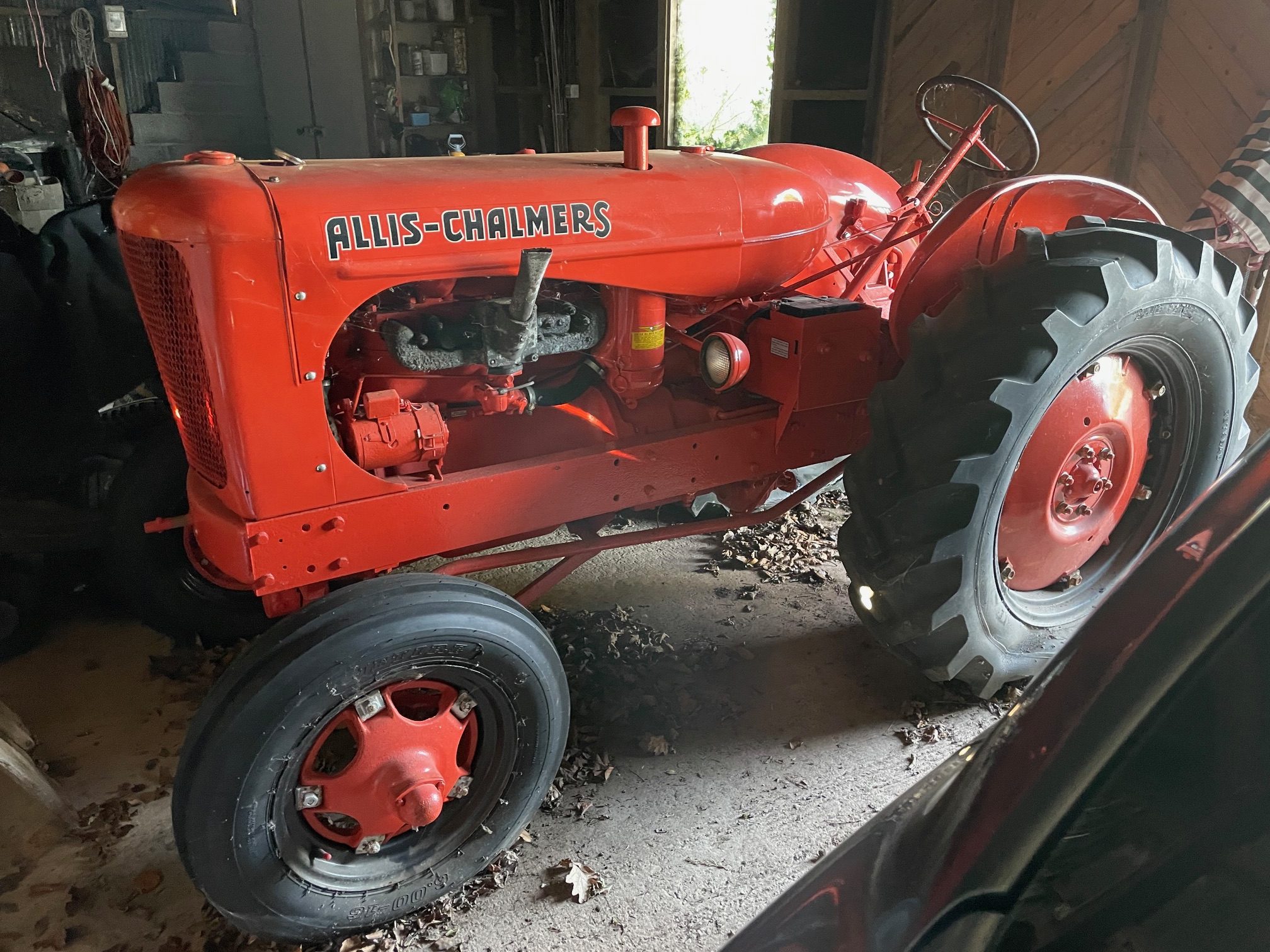
The restored Allis Chalmers Tractor
Recently the tractor was restored and it was hoped that the restoration would be complete for Alan (Geoffrey and Aubrey’s father) to drive it out on the
big annual tractor run. Alas, Alan died suddenly before it could be quite completed. The tractor is still lovingly kept in the possession of the Hosegood family.
The following photographs are from 1946 and show the Allis Chalmers baling machine on the Hosegood farm.
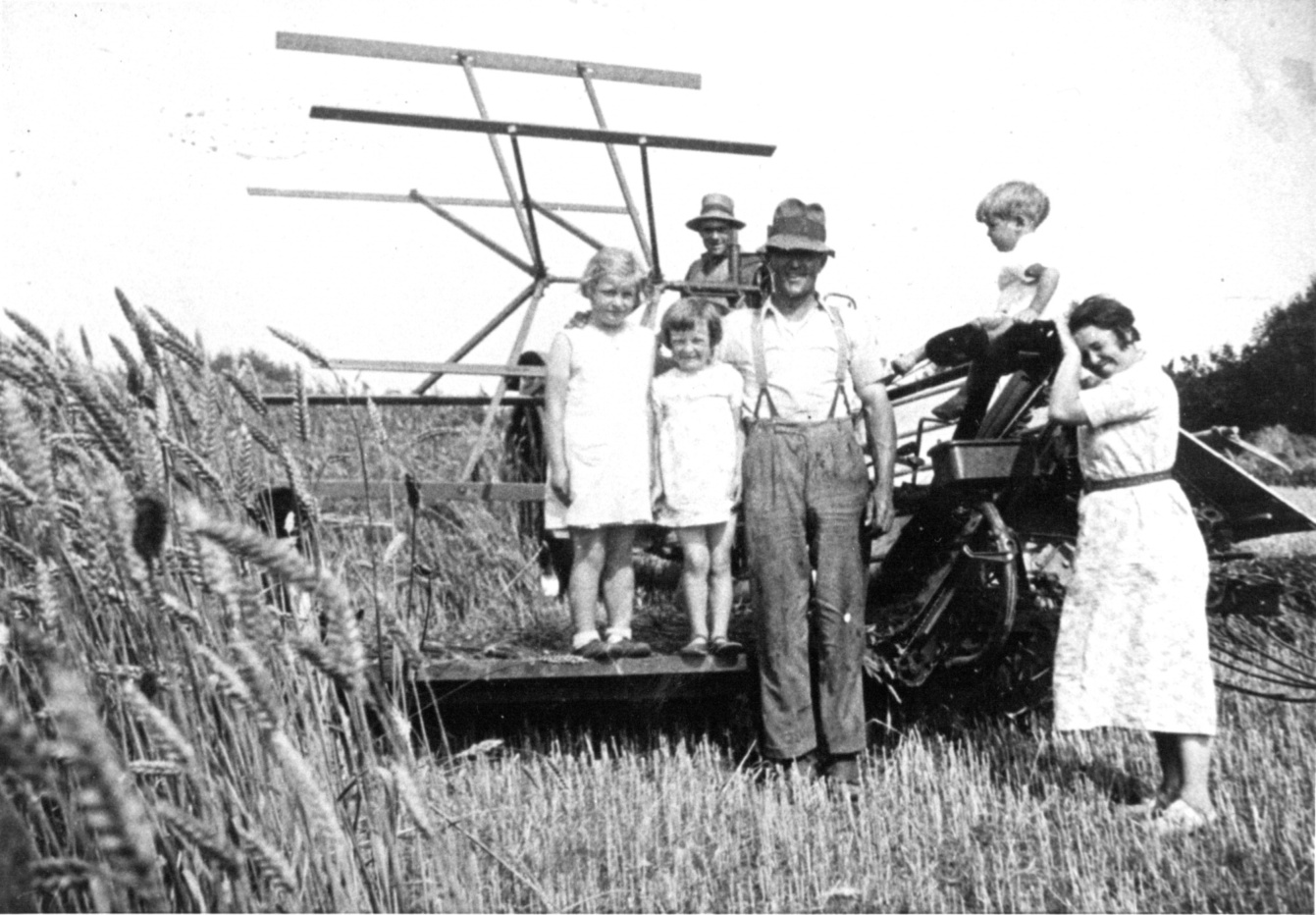
Aubrey Hosegood (senior), Jane Hosegood, their son, Alan sitting on the Allis Chalmers baler. Two little girls who were cousins of Alan: Jean and Lorna Webber. Standing in the back is Ivan Spaduti. (Spaghetti).
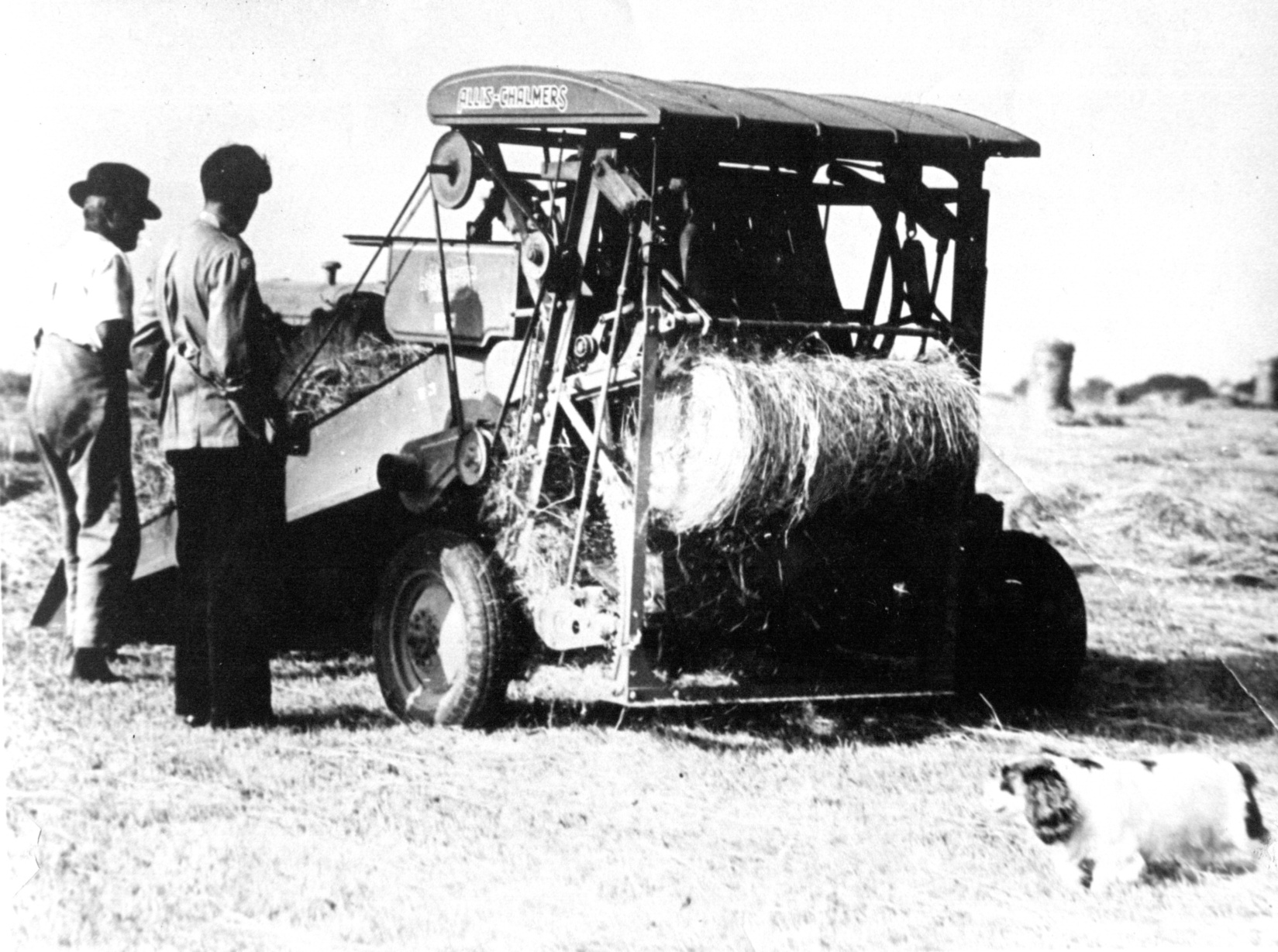
Aubrey Hosegood (senior) with a farm rep. looking at the Allis-Chalmers round bailer.
My name is Ron, I am 87 years old and I was nearly 2 when World War 2 broke out.
Here are a couple of stories that I can remember as the war carried on. I obviously can’t remember the very early days as I was too young. However, I clearly recall going into the cupboard under the stairs when the German planes came overhead and dropped bombs around us. Fortunately they did not hit us.
The house we lived in was only a couple of miles from Northolt RAF station and airfield, which is where the Spitfire planes took off to shoot down the German Bombers.
One Sunny day, in the Summer of 1944, I was just 6 years old and we had been at war since 1939, my mum, my sister and I were siting having lunch at the dining table, which was really an indoor shelter used as a table and which we also used to sleep under at night. (These were called Morrison Shelters.) The doors were open and we were eating
rhubarb and custard when suddenly we heard the drone of an engine above. This noise came from a flying bomb called a Buzz Bomb or a Doodle Bug. They had no pilot and
were packed with explosives.
It flew past our house and as it came into view, my mum, my sister and I quickly slid under the table/shelter in case the engine stopped. Had it done so the flying bomb would
have fallen out of the sky an exploded on the ground or on a building. As the flying bomb passed, my sister’s arm came out from under the table and she grabbed her rhubarb and custard dish and took it under the table and carried on eating.
She had no intention of missing out on it.
We used to walk to school every morning with our gas masks around our shoulders. This was in case a bomb was dropped nearby which contained poisonous gasses. We also used to collect bits of shrapnel which were pieces of metal that came from exploded shells fired from the ground at the passing bombers as they flew overhead. The pieces of metal fell from the sky and had they hit anyone that would have been very serious.
Fortunately most of the bombing was done at night and most people would have been in a shelter then.
Ron also told us that one day a neighbour came across the road to say that the Germans were coming along the train line nearby. Everyone panicked but it turned out to be the local Home Guard.
Ron’s father was a policeman and was very often on duty. A dangerous job in London but a reserved occupation which meant he didn’t join up with one of the armed forces.
Margot was born in February 1941. Her family: Mother, Father and two brothers, lived in Monchengladbach, Western Germany.
Soon after the start of the war her father had to join the German army under the conscription rules. He was a very reluctant soldier. The family went off to Berlin where he went through his army training.
He was sent off to join the forces on the Eastern Front, a very brutal theatre of war, where very sadly he was shot by Russian troops in 1943. Margot’s mother did not know that he was dead for many years and used to go and wait for trains to arrive back with the German soldiers who had survived on the Eastern Front or who had been prisoners always hoping he would be on it but alas he never did arrive and she was only told of his death much later on. She hung on to the hope that he would one day come home.
The family, then back in Monchengladbach, were very poor and resorted to go and live for a time with her grandfather in her uncle’s house. There was no food but they had to get by. Margot memory takes her back to sheltering in the cellar of the house and listening to the bombing going on outside. There was water coming up through the cellar floor with rats swimming in it. Although the way out was difficult through the water at last her mother was able to take her crying daughter up the cellar steps and out.
Her mother got a job in a restaurant and was able to bring back some food for the children although it was still very little. The family had to move on and try to find their own accommodation. Whilst on the list for government housing they lived with an aunt ( her mother had six sisters and one brother). During the journey by train to her aunt’s house, the train was bombed and part of it destroyed. They had a lucky escape there. They were given a government wooden chalet type house.
Margot remembers the local police coming round to the house to tell them that there was going to be a train passing through at 8.00pm which had a wagon full of basic biscuits . People from the village including Margot’s family turned out to get some. When it arrived the local police opened the side of the wagon (carriage) and the biscuits cascaded out. Margot’s mother was able to collect some of the broken ones from the fall out. Later that evening the Gestapo came around to all the houses and were shooting people who had any sign of the stolen biscuits. Luckily Margot’s mother had hidden her supply well away and not a crumb was found so once again they had a
fortunate escape.
Margot and her family continued to live a very frugal life. Her school teacher sometimes would ask her to stay behind when the other pupils had gone home. She was worried at first that she was in trouble for some misdemeanour, but her teacher had realised that she came from a very poor family and gave her parcels of clothes, shoes and food to take home.
In spite of all these hardships, her family were always very close and as soon as she could Margot started work, passing up an opportunity to go as housekeeper with a rich family to Oslo as she wouldn’t leave her mother alone. She got a job at the the British Army Base at Rheindalen where, after a while she met and married her British army officer husband of 45 years.
Jean was born after the war but grew up at Affeton. She remembers Francis Allen’s parents, John and Fanny, very well.
John Thomas was the local gamekeeper and was always dressed beautifully in the traditional tweed outfit and cap. He was a much respected man.
Francis’ sister Evelyn looked after Jean when she was a little girl. Jean, of course, did not know Francis but Evelyn was reported to have said that the the last time he left Affeton to go back to the war after being on leave, he commented as he looked up at the tower:
I wonder if I will ever see the tower again.
And, alas, he didn’t.
Jean remembers that there was POW camp on the Tiverton road not far from Nomansland at Pages Crossroads just before Cruwys Woods. The men from the camp were sent to work on local farms and that after the war they returned for a reunion.
Whilst they were here they etched their names on the timber panelling around the well (village pump) in East Worlington. Alas that panelling has since been taken out and replaced by modern timber thus loosing that historic relic. [Ed. the panel can still be seen by the village pump].
One of the men named Otto returned to Affeton a number of times and Jean remembers him well. After the war and in the early 1950s Jean was much loved and looked after by Francis’ parents and sister who spoiled her with lovely gifts many of which she has kept.
Jean also has a tin hat which belonged to the village Home Guard.
Gillian lives at Northlake Farm in the parish of Lapford, nearly on the Southerly boundary of Worlington, where her family have been since the early 1960s.
During the war her mother, Sylvia Govier, was living with her parents and siblings at East Leigh Farm near Colebrooke. The family subsequently moved to Pedley
Barton Farm in Thelbridge Parish.
Edmund Stals was a Latvian prisoner of war who was living in a camp in Winkleigh. He was sent to work at East Leigh farm where he had a natural aptitude for looking after the shire horse. By chance he met up with four cousins at Winkleigh camp who all stayed and worked in England after the war too.
During his time there he and Sylvia became sweethearts and so Edmund stayed in the area after the war and in 1950 he and Sylvia were married at Morchard Bishop church. They lived and worked in New Buildings until they moved to Northlake Farm in the early 1960s where Gillian and her brother grew up and where Gillian is still living.
Edmund returned to Latvia in the years after the war for a visit to see his mother but was eager to return to Devon and his family.
Edmund died in 1999
Recalled by Violet Stoneman, on Behalf of Diana Stone.
Many village people will remember Diana Stone who was very active lady in the village WI and Parish activities.
Her brother Sergeant Vernon Coaker (and Uncle of Winston Stoneman) was killed on D Day having successfully made landing with his bicycle and crossed the beaches.
He died when a bomb landed near the Post Office at Le Plein (Amfreville).
His gravestone is in Ranville War Cemetery, Normandy. He is remembered on the war memorial in Chulmleigh.
Violet’s father was Post Master at East Worlington Post office from 1971 to 1973 but before that, he had previously spent time as a child as a local boy in a cottage in Cheldon. He had an extraordinary war career in the Royal Navy working his way up the ranks from Boy Second Class.
The following short summary shows the extent of his most dangerous wartime missions (in the middle of it all he had leave and got married):
- He saw service on a number of Royal Navy Ships sailing all around the world through some of the most dangerous theatres of the war and working on some of the well known Royal Navy war ships.
- South America to Nova Scotia. Then on to escort one of the first Atlantic convoys across the Atlantic Ocean. Minelaying in the Denmark Straits and around Iceland.
- He describes gruelling experiences with the North Atlantic convoys, around the Norwegian Fiords and onward to Russia.
- In 1943 his ship HMS Montrose (He was now a Petty Officer) headed down through the North Sea defending the East Coast convoys where they were under heavy attack.
- He took leave for 6 weeks with more training before leaving from Glasgow to join a troop ship leaving for the Middle East. He saw service in the Mediterranean then back to Southampton and in June 1944 he took part in the D Day landings.
- He was part of the crew on the escort ship for George V1 visiting the troops in France.
- His next journeys took him to join the Pacific Fleet in Perth via Gibraltar, the Mediterranean, and on to Ceylon.
- After Australia he went on to The Philippines where his ship joined the war in Japan and were attacked by the Japanese air force suicide bombers. Gruelling stories from here with the war raging on when VE Day was announced in the West.
- He was seriously ill with TB and was taken to Australia for hospitalisation on a hospital boat. He lost much weight but survived to return to England after Christmas 1945 and to meet his baby daughter Violet for the first time.
He went on to live a long and productive life with his family. He died in 2001.
Return to 'VE80 Exhibition'