
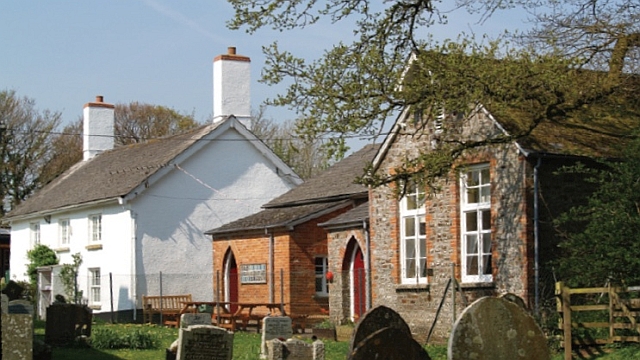
As far as possible, East Worlington School tried to continue as normal teaching typically 40-60 but this was supplemented by a number of evacuees in 1940. The headmistress Mrs Harry (1940 onwards) “moonlighted” to give radio broadcasts from Bristol.
The total number on roll pre-June 1940 averaged about 38. No evacuees had yet made their way to East Worlington. However, this was to change by the end of June when 25 evacuees arrived.
Consider the impact of this on such a small school and on the whole community. At the time, the school had only 2 classrooms, and had children up to the age of 14.
| Date | Devon Scholars | Private Evacuees | Official Evacuees | Total on Roll |
| 1940 May | 38 | 0 | 0 | 38 |
| 1940 June 24th | 38 | 3 | 25 | 66 |
| 1940 July 2nd | 38 | 5 | 28 | 71 |
| 1940 July 26th | 37 | 4 | 15 | 56 |
| 1940 Sept 27th | 36 | 6 | 13 | 54 |
| 1941 Feb 14th | 33 | 7 | 14 | 54 |
| 1941 April 22nd | 34 | 7 | 16 | 57 |
| 1941 June 3rd | 34 | 8 | 18 | 60 |
| 1942 Jan 30th | 35 | 1 | 12 | 48 |
| 1942 May 1st | 42 | 1 | 10 | 53 |
From January 1943, the number of evacuees dropped to one or two, and by the end of the war, there were 28 Devon children with 1 evacuee.
Devon numbers were lower from 24th April 1944 when, following the EducationAct of 1944, children were transferred to Chulmleigh senior school,leaving only infants and juniors at East Worlington.
Mrs Harris, who had been in post since 1924. However, she left in February 1940 and was replaced by a series of temporary heads until the appointment of Mrs Edith Sarah Harry, who took charge of the school on 20th May 1940.
Mrs Harry was to lead the school for most of the war period, leaving on 28th March 1945 to become head of Haywards in Crediton. She and her family would have lived in the School House.
One of the interesting things about Mrs Harry is that she was absent, with leave, for eight occasions during the war, in order to make radio broadcasts. Presumably, after the success of the first one, she was asked to do more.
The dates and subject, where known, are:
|
19-Nov-1941 |
Evacuated children in the village |
|
11-Mar-1942 |
Village Aid to Russia |
|
3-May-1943 |
Elbows on the table – manners |
|
23.-AUg-1943 |
|
|
19-Nov-1943 |
(Bristol) |
|
16.-Dec-1943 |
(Bristol) |
|
9-Mar-1944 |
|
|
13-Sep-1944 |
(Bristol) |
Somewhat of a local celebrity, then!
As far as possible, the school tried to continue as normal. There were tests and exams and visits from the School Nurse and other medical practitioners, the latter particularly important for screening the evacuated children. There were also the usual regular inspections.
In addition, there were other visits related to the war and the war effort, such as Civil Defence meetings for the staff to attend. On 7.10.42. we are told that the Chief Air Raid Warden for the area called at the school “to inquire about plans for the school during a raid. He advised dispersal in the field if time allowed, and, if not, he recommended that the children be made to lie on the floor in school, under desks” Presumably, the children had regular practises of this, along with gas mask drill. On another occasion, the school had a visit from Rev. G Elliott, Civil defence Instructor, who came to talk to the children about anti-personnel bombs!
In common with most other schools and organisations, the school was very active throughout the war, in fundraising for the war effort.
Collections were held as part of the Empire Day schools collection to raise money for the League Tobacco Fund “to provide cigarettes and tobacco for members of His Majesty’s forces serving overseas”. A total of £3.10.6 was raised over the war years.
On 1st August 1940., we are told in the log book “A successful concert was given in the Parish Hall last evening by the school children and a sum of £8 was made with which to buy materials for the making of hospital clothes for The Red Cross. The clothes are to be made by the girls, as part of the War Campaign”. Three other concerts were given by the pupils over the years, to raise money for various campaigns. As a result £7.11.3 was raised for Mrs Winston Churchill’s “Aid to Russia” fund; contributions were also made to the “Wings for Victory” savings campaign and “Salute the Soldier” savings campaign.
On 2nd August 1940. the school closed for the summer holidays, but the headmistress wrote “Throughout the holidays, the staff are to conduct a War Campaign Participation by the children, to be voluntary. They are to be encouraged to any kind of work which may be of use in the National War Effort, such as collecting waste, helping local farmers with harvest etc. clearing weeds, fruit gathering, knitting and needlework. A weekly return is to be sent in, stating the number of hours of useful work done by the Children”. Unfortunately, it isn’t recorded how many hours were completed.
In March 1944 Worlington excelled in a Book Salvage Drive. The school was head of the district. 3,500 books were collected, an average of 109 per child. The next best school averaged 78 per head. As a result of this splendid achievement, a day’s holiday, on 20th March, was granted by the managers.
Perhaps the most important entry in the wartime log book, certainly as far as the children, and indeed the whole village was concerned, was that on
8th and 9th May 1945
“SCHOOL CLOSED FOR 2 DAYS FOR THE CELEBRATION OF THE V.E. DAY HOLIDAY”
Return to 'VE80 Exhibition'