
Some Background
Dilapidation in church buildings became a widespread, chronic problem starting in the mid-16th century following the Reformation, and reached a critical crisis point by the mid-19th century due to centuries of neglect, changing demographics, and structural failures. Dilapidations are breaches of lease covenants regarding the repair, maintenance, or alteration of a property, requiring a tenant to return the premises in a specific condition, often “good and substantial repair”. IRectors historically lived in rectories primarily because the house was part of their “living” (benefice), serving as their home and administrative base in exchange for leading a parish, which was considered a lifetime appointment. The rectory was generally owned by the church to ensure the pastor remains local, accessible, and housed, regardless of their personal wealth.n England the person responsible for the condition and maintenec of church buildings was and was rhe Recotor, who did not own the buildings including this residence, the Rectory but lived there as a Rector did not own any o the properties of the church wthin the Parish There is evidence to sustanciate that the church properties of East Worlington had fallen into a state of disrepair and poor condition.
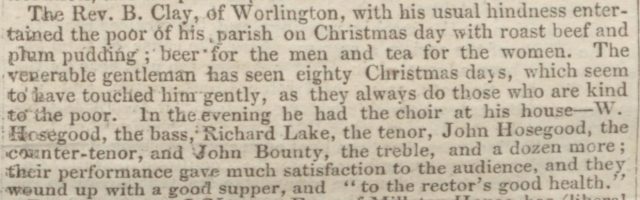
From 1796 to his death in 1851 the Rector of East Worlington was Reverend Benjamin Clay. There are several sources of evidence, mainly hrough press articless that describe Clay as a kind man.
Tithe apportionments are detailed records created following the Tithe Commutation Act 1836 that converted in-kind church taxes (tithes) into monetary payments, known as rent charges. These documents, often accompanied by maps, list landowners, occupiers, land use, and acreages, serving as a comprehensive survey of land ownership in England and Wales in the 1830s-1850s.
At the time of the death of Benjamin Clay the property was in poor condition and the incumbent Recotor, Bryan made a claim to Clay’s executor, against the estate of Benjamin Clay for the funds necessary to repair the buildings to good condition. However it apears that Benjamin Clay was in debt to 41 persons and the Executor had paid these dues from the Estate and there were no other funds available to pay for the necessary improvements to the property.
This clearly indicated that in 1851 thed property was in delapidated condition and had been allow to deteriorate into poor condition over a period of time by the incumbent. It is difficult to ascertain exactly when the lack of maintence started to impact on the buildings as in White’s Directory for DEvonshire in 1850 offered the following discription, ‘The Church (St. Mary,) is a small ancient structure, with a tower containing four bells, and crowned by a short spire. The rectory, valued in K.B. at £7. 15s. 10d., and in 1831 at £238, is in the patronage of the Hon. Newton Fellowes, and incumbency of the Rev. Benj. Clay, M.A., who has a neat thatched residence, and 66½A. of glebe.” which does offer any indication it is a prperty in decay, infact the opposite.
with a cross on each side of it, which has been the subject of much antiquarian conjecture. The Church (St. Mary,) is a small ancient structure, with a tower containing four bells, and crowned by a short spire. The rectory, valued in K.B. at £7. 15s. 10d., and in 1831 at £238, is in the patronage of the Hon. Newton Fellowes, and incumbency of the Rev. Benj. Clay, M.A., who has a neat thatched residence, and 66½A. of glebe.”
Benjamin Clay, deceased, in his lifetime and at the time of his death, to wit, 7th December, 1851 , was rector of the parish church of East Worlington, in Devonshire,and was seised, in right of the rectory, of and in a certain messuage, to wit, a messuage called The Rectory, and of and in certain, to wit, twenty, outhouses, &c. (enumerating various buildings), and twenty gardens, and of and in the chancel of the parish church, and of and in certain, to wit, one thousand, acres of glebe lands, and died so *seised thereof : and plaintiff, after the death of B. Clay, to wit, on 24th February, 1852, was presented to the rectory, and [*39 awfully instituted and inducted into the same, so being void by th death of B. Clay, and thereby then became and still is rector of the rectory, and next successor of B. Clay : averment that, at the time of the death of B. Clay, the said messuage and the said outhouses, &c . , and the said chancel, and the walls and fences of and belonging to the said gardens and glebe land, were respectively out of repair and greatly dilapidated, &c., for want of due repairing by B. Clay in his lifetime, and were so left by B. Clay out of repair, &c. , at the time of his death ; and that the sums of money necessary to be expended for necessary repairing of the premises amounted to a large, &c. , to wit, 2947. 16s.; of all which defendant, so being executor, &c. , after the death of B. Clay, and the presentation, institution and induction of plaintiff, and before the commencement of the suit, had notice, and was requested to pay the said sum to plaintiff :
The theme of delapidation certainly remain an aspect of eclesitacial buildings in East Worlington when due to the poor condition of the church in 1879 the patron, the Eart of Portsmouth funded the rebuild of the church to the sum of approxiamately £1,000.
During the first half of the 19th Century East Worlington was not known as a wealthy parish
It was a concept that applied to all the building
Dilapidation and
Dilapidation in church buildings became a widespread, chronic problem starting in the mid-16th century following the Reformation, and reached a critical crisis point by the mid-19th century due to centuries of neglect, changing demographics, and structural failures
While St. Mary’s Church, East Worlington, isn’t described as currently in
poor condition in recent snippets, it has a history of dilapidation leading to significant Victorian restorations, with some locals disliking the Victorian look, and weathered features like finials and graves showing ongoing natural decay, suggesting ongoing maintenance challenges typical for old stone buildings with thatched roofs. The church is structurally sound enough to host community events, but its historic nature means parts, like roof finials, require constant attention
The Ecclesiastical Dilapidation Act 1871 was needed to establish a consistent, fairer system for repairing Church of England clergy residences (glebe houses) and other benefice buildings, addressing the chaotic situation where outgoing incumbents or their estates often faced sudden, massive repair bills, creating hardship and disputes, by introducing mandatory surveys and designated funds for maintenance
. Before the Act, repairs were haphazard, leading to decaying properties and financial burdens, so the Act aimed to ensure buildings were kept in good order for future clergy.
Key Reasons for the Act:
- Financial Hardship for Clergy: Incumbents were legally responsible for maintaining their official residences (parsonages, rectories), but wear and tear often accumulated, leaving the next priest with huge, unexpected repair costs, sometimes bankrupting them or their estates.
- Lack of Standardisation: There was no uniform way to assess necessary repairs, leading to inconsistencies and arguments over the extent of work required when a benefice changed hands.
- Deterioration of Property: Neglect of buildings meant they fell into disrepair, impacting the living conditions of clergy and the appearance of church property.
- To Create a System: The Act introduced a system where diocesan surveyors, appointed by bishops, would inspect buildings and assess repair costs, with funds collected (often from the outgoing incumbent or their estate) to be used for the necessary work.
Before the Ecclesiastical Dilapidations Act of 1871, the maintenance of rectories (parsonage houses) in England and Wales was a notoriously problematic system based on customary law rather than standardized inspection.
Key aspects of the situation before 1871 included:
- Personal Liability of the Clergy: Rectors were legally responsible for maintaining their houses, but this was a personal liability often enforced through the ecclesiastical courts after a vacancy occurred.
- “Dilapidations” System: When a rector died or moved, their estate (or the new incumbent) was liable for “dilapidations”—the cost of repairs. This often led to disputes between incoming and outgoing incumbents.
- Neglect and Lack of Oversight: While archdeacons were supposed to inspect parsonage houses, they often became slack in their duties over time, leading to significant neglect of the properties.
- Financial Burden: Repair costs often fell heavily on new incumbents, who sometimes had to bear the cost of renovations or accumulated neglect from previous generations.
- Glebe Terriers: From 1571 onwards, surveys known as “glebe terriers” were ordered to be made, which sometimes detailed the state of the parsonage house.